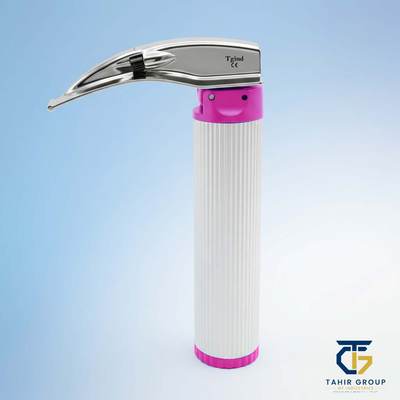
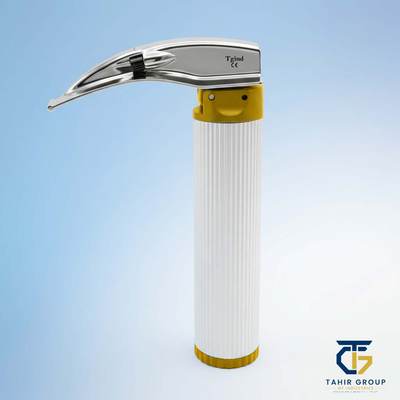
Diagnostic instruments Fiber Optic Laryngoscope
Web reference TGI-C-7E3603E9 Quote this to us. It identifies this page, not a factory part number.
Also called Direct Laryngoscope
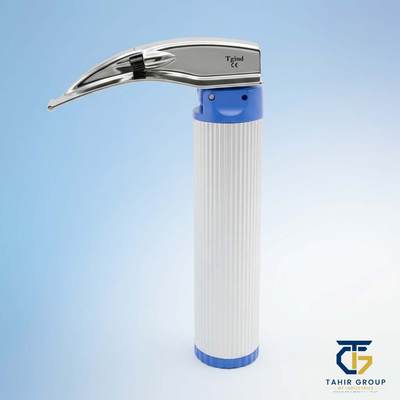
Light reaches the blade tip through a fiber-optic bundle run from the handle, rather than a bulb mounted at the blade tip.
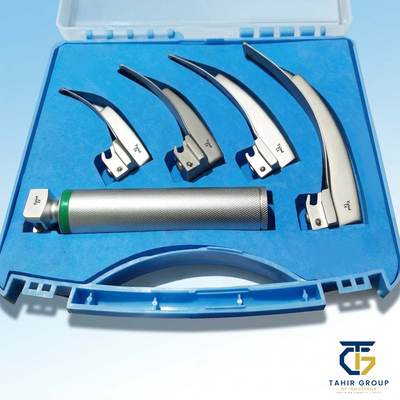
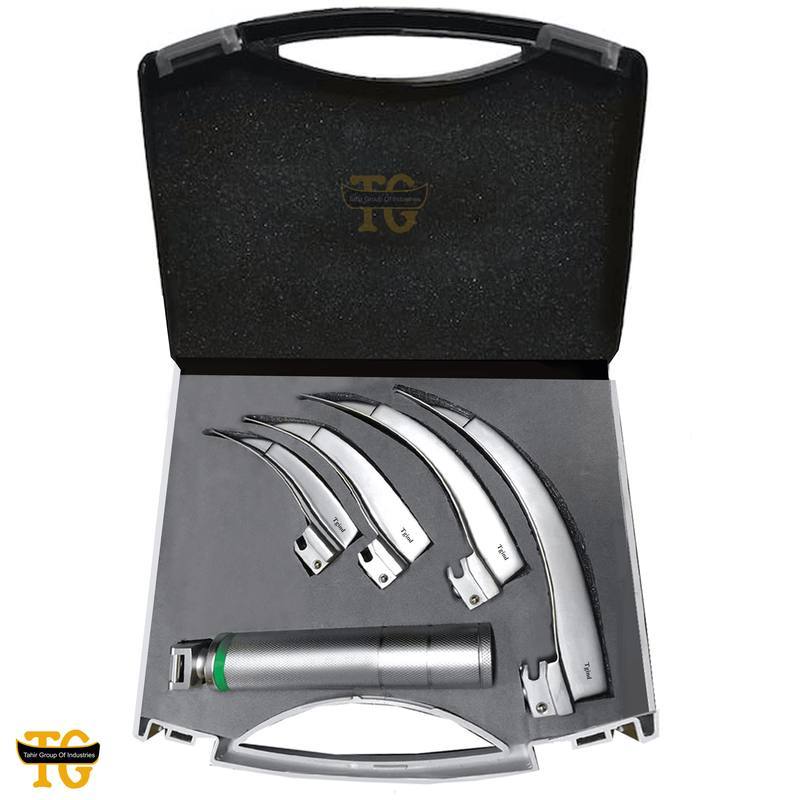
A laryngoscope for direct laryngoscopy is two parts, a handle and a blade, joined at a hook on fitting set out in ISO 7376 so a blade can be changed without changing the handle. The handle is a cylindrical grip holding the batteries, and on a fibre optic handle the lamp as well. The blade is made in two shapes: curved, the Macintosh pattern, placed in front of the epiglottis, and straight, the Miller pattern, passed under it, each in a numbered size series. Light comes either from a lamp mounted in the blade near the tip, which ISO 7376-1 covers, or through a fibre bundle from a lamp in the handle, which ISO 7376-3 covers and the trade calls the green system; the two fittings do not interchange. It is most often confused with a laryngoscope set, which is one handle sold with a range of blades in a case, and with a flexible fibreoptic laryngoscope, a different instrument that is not rigid and is used to examine the larynx in an awake patient.
Minimum order 150 pcs The minimum published for this article. Mixed orders are quoted against your list.
Lead time Instruments ~2-3 weeks · full sets ~4-6 weeks after advance.
Quality control
The inspection step is set by the line you order.
- Economy line
- sample: visual + dimensional
- Clinical line
- sample + boil test
- Premium line
- tighter sample + hardness test
- Executive line
- 100% inspection + laser mark
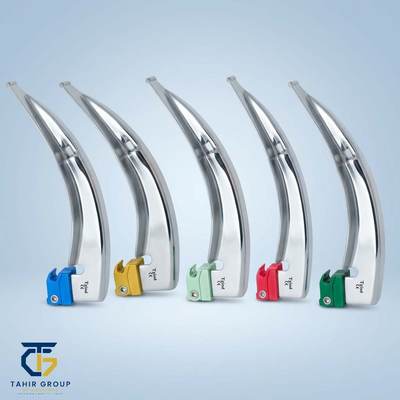
Finish A colour is a second choice, made on top of the line. Coloured finishes on request, on any instrument, in addition to the steel line. Evidenced: black · gold · rose gold · blue · rainbow (anodised titanium).
How it is built
- Two parts: a reusable handle and a separate blade that detaches from it
- Blade and handle join at the hook on fitting set out in ISO 7376, part 1 for the lamp in the blade and part 3 for the fibre optic green system
- Curved blade, the Macintosh pattern, and straight blade, the Miller pattern, are the two base shapes, each made in a numbered size series
- Conventional illumination puts the lamp in the blade near the tip; fibre optic illumination puts it in the handle and carries the light down a bundle to the tip
- Levering tip blades, the McCoy pattern, hinge the last part of the blade on a lever worked from the handle, usually on a curved blade body
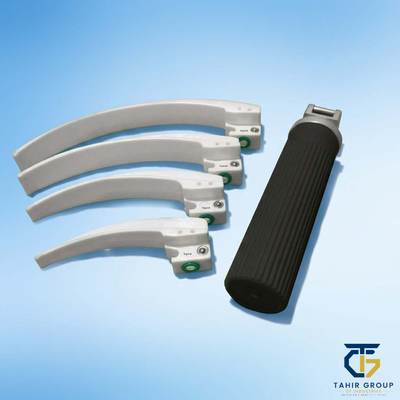
- Blades are made reusable in metal and single use in metal or moulded plastic
- Handles are made in more than one size: a standard handle taking a C cell, a small handle taking an AA cell, and a stubby or short handle taking an AA cell in a shortened body for working in a confined space
- Handles run on disposable alkaline cells or on a rechargeable pack
Patterns Macintosh, curved blade · Miller, straight blade · McCoy levering tip · Conventional illumination, lamp in the blade · Fibre optic illumination, lamp in the handle, the green system · Single use blade
The standard sizes this kind of instrument is made in
Macintosh curved blades are made in a numbered series running No. 0 for an infant to No. 5 for an extra large adult, with No. 3 the size most widely stocked · Macintosh No. 5 was found published only as a fibre optic blade in the catalogues read · Miller straight blades are made in a numbered series running No. 00 for a premature newborn to No. 4 for a large adult · Miller No. 4 is made both with the lamp in the blade and as a fibre optic blade, so it is not a fibre optic only size · Handles: a standard handle on a C cell, a small handle on an AA cell, and a stubby or short handle on an AA cell · NO BLADE LENGTH IN MILLIMETRES IS PUBLISHED HERE. Catalogues give different lengths for the same numbered size, by as much as 18 mm on a No. 3, and they measure from three different points, the overall length, the length from the inside of the base to the tip, and the working length. The size number is what a blade is ordered by; a millimetre figure would have to name one maker and one way of measuring, and would then not be a fact about the trade
These are the sizes the pattern is manufactured in across the trade. They are not a stock list. Tell us the size you need and we will quote against it.
This describes the laryngoscope as an article. 9 other articles in this catalogue share it: the sentence above is what separates this one. This describes the article. The steel, the finish and the inspection step are set by the line you order.
Full specification
A full specification is published for an article of this name: its own minimum order, the sizes it is supplied in, and where it is a set, what the set contains.
Material and quality
| Line | Steel | Origin | Finish | Inspection |
|---|---|---|---|---|
| Economy line | AISI 410 | Pakistani or Taiwanese | satin, passivated | sample: visual + dimensional |
| Clinical line | AISI 420 | Pakistani or German | satin, passivated | sample + boil test |
| Premium line | AISI 420-440C | German or Japanese | fine polish, passivated | tighter sample + hardness test |
| Executive line | AISI 440C | German or Japanese | mirror polish, passivated | 100% inspection + laser mark |
This is the steel each line is made from as standard. A different origin can be supplied on request (a lower grade in Japanese steel, for example), agreed on your order.
Premium is the line where the choice is yours: 420 or 440C, agreed on your order. Economy is always 410 and Executive is always 440C. Those three are the instrument steels. Hollowware and sterilisation containers are made in AISI 202 on a Clinical order and AISI 304 on a Premium or Executive one, and they are not offered in the Economy line at all, which is the section above.
True of every order
Instruments are marked to the buyer's requirement (TGI, unmarked, or the buyer's own brand), agreed on the order.
Customised packaging is part of what TGI supplies. Your own printed boxes, your labels, your brand on the pack, or plain export packing, whichever your market needs. The packing for your order is agreed with you and confirmed on the order.
Manufactured under the quality management system covered by TGI's ISO 9001:2015 and ISO 13485:2016 certificates. Certificate numbers and the issuer's registry are on the certification page. Open the certificates
Every batch of steel is ordered to a specified grade and arrives with the mill's own certificate, which identifies the mill and states the grade. TGI checks the material at the factory against its own requirement before it goes into production. That check is TGI's own inspection, not an independent laboratory test.
TGI manufactures in its own factory in Sialkot and also supplies articles made by contracted partner workshops, to TGI's specification. Which applies to a given article is confirmed on your order.
One-year guarantee on Premium and Executive tier instruments, hollowware and sterilisation containers: any technical manufacturing defect, including material faults and rust, is replaced free of charge. Damage from handling or accidents is not covered. The year runs from the day the goods leave Sialkot.
If something is wrong with a delivery (a manufacturing defect, or a short or wrong article), tell us on WhatsApp within 7 days of delivery, with a video and photographs of what arrived. Replacement instruments are sent free of charge and dispatched within 24 hours of us seeing them; you pay the shipping, and they reach you as a normal order does.
Damage that happened after the goods left Sialkot is a claim against your carrier. The video of your parcel at the shipping office is sent to you before shipment and is the evidence that claim needs.